
A European spacecraft heading to Jupiter has caught the most detailed image of the comet that had astronomers perplexed and worried it might hit the Earth
The interstellar comet 3I/ATLAS sparked panic among scientists last year when it was discovered there was a small chance it would strike us.
But fears quickly dissipated after further observation, though its unusual nature still had experts baffled and fascinated.
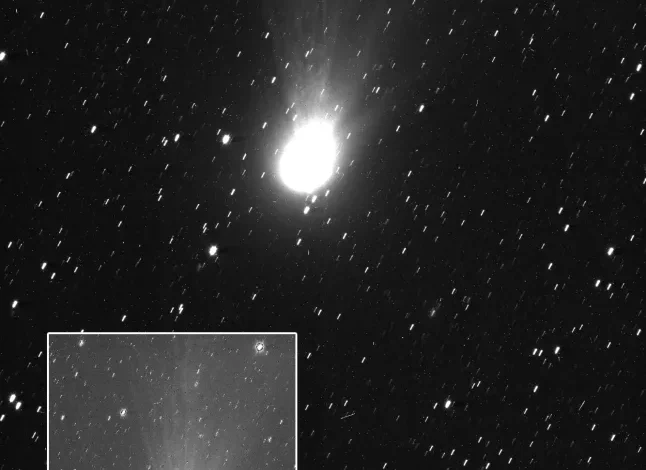
This striking image from the science camera on ESA’s Jupiter Icy Moons Explorer (Juice) is the closest look we have had to date. It shows the object spewing dust and gas as it continues on its path.
Humanoids
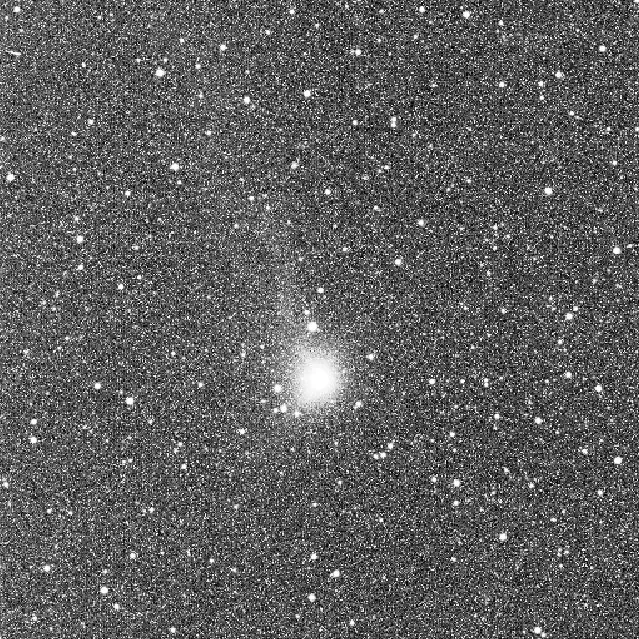
The tiny nucleus of the comet (not visible) is surrounded by a bright halo of gas known as the coma. A long tail stretches away from the comet, and we see hints of rays, jets, streams and filaments.
The inset in the image shows the same data, but processed to highlight the coma structure. The arrows in the top left indicate the direction in which the comet was moving (blue) and the relative direction of the Sun (yellow).
While 3I/ATLAS is a visitor from interstellar space, travelling from outside the Solar System, its behaviour is completely in line with that expected from a ‘normal’ comet.
The camera, named JANUS, took this image on November 6 last year, just seven days after the comet made its closest approach to the Sun. At the time, Juice was about 66 million km away from the comet. It has now been beamed back to Earth.
Throughout November, Juice used five of its science instruments to observe 3I/ATLAS – JANUS, MAJIS, SWI, PEP and UVS. Together, they collected information that will reveal how the comet was behaving and what it is made of.
During the months that followed the observations, Juice was on the opposite side of the Sun to Earth.
It used its main high-gain antenna as a heat shield, and its smaller medium-gain antenna to send back data to Earth at a lower rate. This meant that instrument teams had to wait until last week to receive the data; they are now working hard to analyse them.
In total, JANUS took more than 120 images of 3I/ATLAS across a large wavelength range. The European Space Agency’s instrument team is taking a closer look at all these images to understand what they reveal about the comet.



Christmas tree The dreams The bags for us
Do you Vechaslav Viktorovich he didn t allow that dick It s no one Someone gave a
Nice share!
thank you so much